Mounting a 75 or 85 inch TV
Everything about a large panel is a step change: the weight, the bracket, the number of studs it needs, and the box it arrives in.
A 75 or 85 inch panel is a two person job. It is heavier than it looks, wider than one stud can support, it usually needs a bracket rated well above what a small screen needs, and it wants to sit lower on the wall, not higher. The box is also a problem before the TV is.
Weight, and the number in the manual
Find the weight in the manual or on the back of the box, without the stand. People guess low on this. A thin panel reads as light, and lifting it at waist height in a shop is not the same as holding it at shoulder height against a wall. Whatever that number is, the bracket has to be rated above it, and so does the wall. Brackets are sold with a maximum load for a reason, and that rating assumes the fixings are the ones the instructions specify, driven into something solid.
Two people, not one
Weight is only half of it. A large panel is mostly area, and area means flex. Held by one person at two corners, a big screen bends, and the glass and the bonded layers behind it do not like bending. That is how panels develop a line down them that no one can explain afterwards.
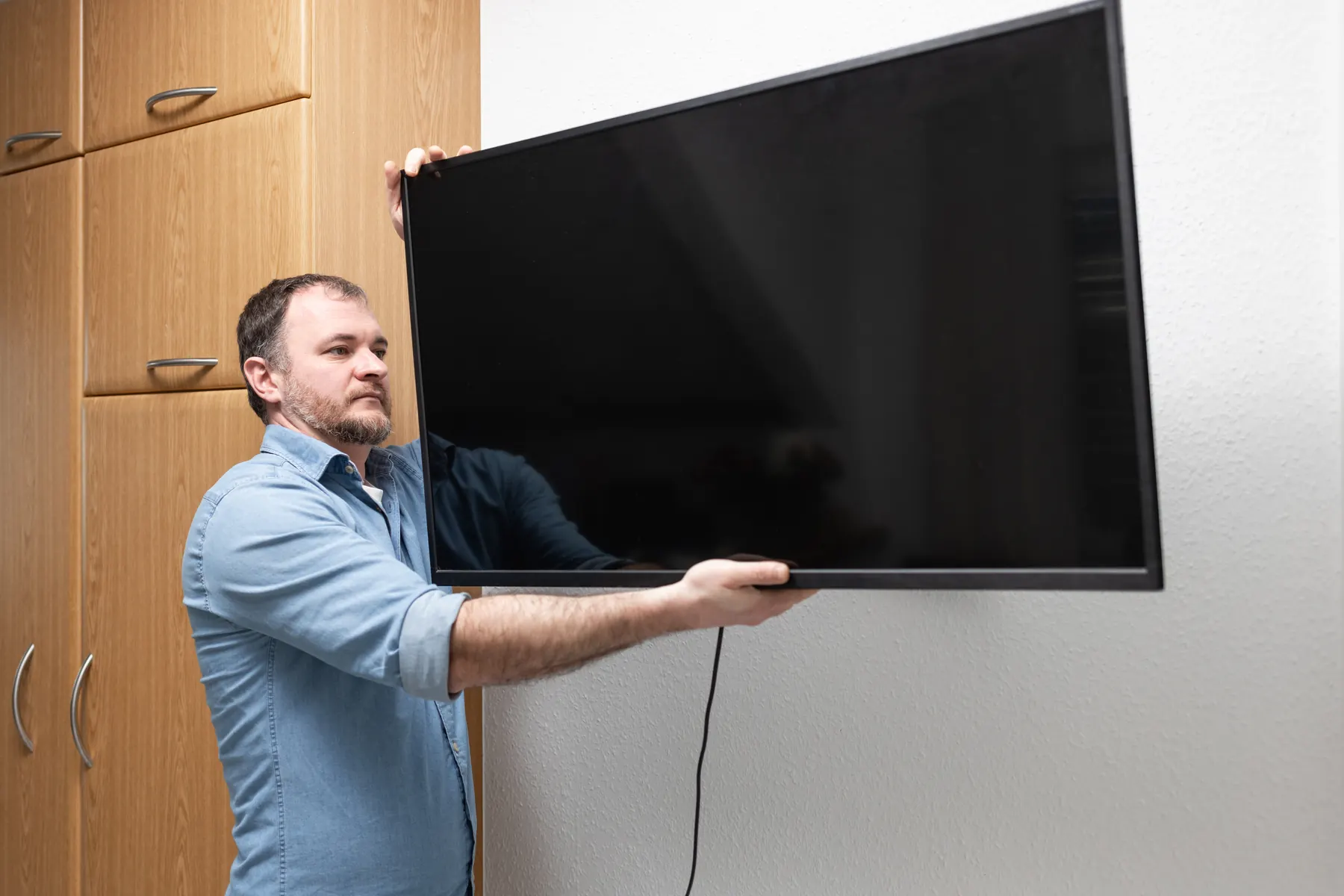
Then there is the hanging itself. The arms on the back have to drop onto the wall rail, or the set has to be held square while a bolt is started, and none of that can be done while also carrying it. One person can mount a small screen. Two people mount a large one, every time.
VESA patterns get large
The VESA pattern is the grid of threaded holes on the back, measured in millimetres between centres horizontally and vertically. Small screens are often 200x200 or 400x400. Large ones commonly run to 600x400, and some go wider or taller again. A bracket that covers the small patterns will not reach the holes on a large set, and adapter plates are not always the answer because they add their own stack of thickness and their own weak point. Check the pattern in the manual before anyone buys a bracket.
One stud will not do
Studs in most homes here sit at 16 inch centres. A large screen is wide enough to span three or four of them, which is good news, because the rail should be bolted into at least two. Lag bolts into the middle of the timber, not clipping the edge, and not into the drywall between.
The failure we get called to is always the same shape: one stud found, the other side held by plastic anchors pushed into plasterboard. That holds for a while. Then a door slams, or somebody leans on the screen, and the anchors tear a cone out of the board and the set comes down onto whatever is below it.
Steel studs change the method. They are thin and they flex, so a lag bolt has nothing to bite. Those walls want toggles rated for the load, or a plywood backing plate spanning several studs so the weight is spread.
The ends of a wide panel
A wide screen is a lever. Push the corner of an 85 inch panel and the force at that corner is working against fixings that are all clustered near the middle of the set. That matters when someone knocks it, and when the screen is on an arm that swings. It is also why the rail has to be dead level: a wide panel shows a small error at the ends as a visible slope across the room.
Lower, not higher
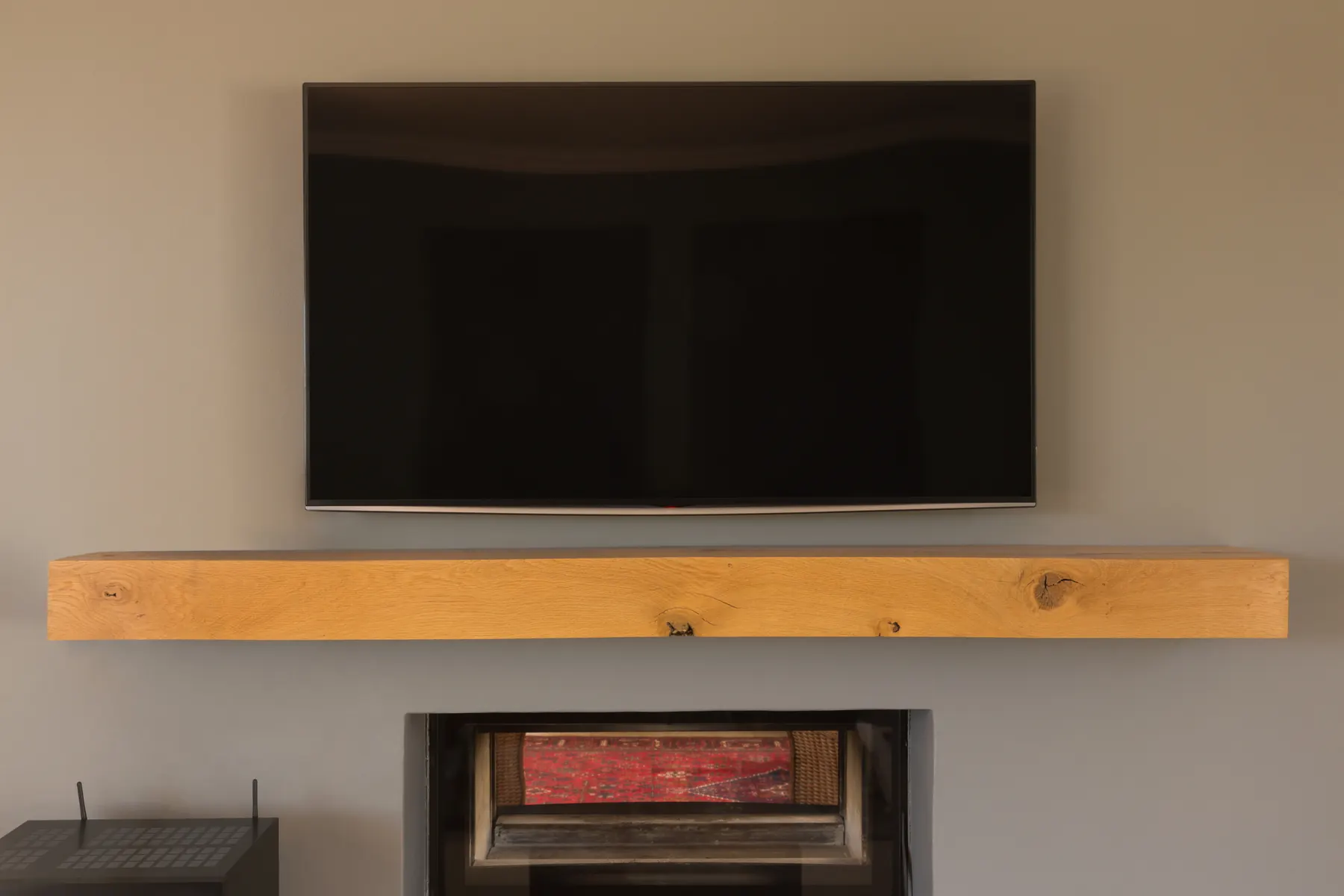
Big screens get hung too high more often than small ones, because a large panel looks like it needs room above the furniture. The opposite is true. The centre of the screen still wants to be near your eye level when you are sitting down, and on a tall panel the centre is a long way up from the bottom edge, so the bottom edge has to start low. On an 85 inch set that often means just clear of the sideboard.
Distance helps too. A rule of thumb that works in real rooms is to sit back somewhere between one and a half and two and a half times the width of the screen. Closer than that and your eyes track across the picture instead of taking it in, and any height error gets worse, because the angle up to the top of the panel gets steeper the nearer you sit.
Getting it into the building
Before any of that, the box has to arrive. An 85 inch carton does not fit in a normal car, it does not fit in some residential lifts, and in a condo it may not fit through the door of the lift you are allowed to use. Buildings often want the service lift booked and a certificate of insurance on file before a delivery that size comes up.
Measure the lift, the turn at the top of the stairs and the door into the room. Unbox in the hallway if the box will not turn the corner, since the panel turns a corner that the carton will not. Call 289-475-5175 with the model and the building and we will tell you what the access needs.