How to find a stud, and why it matters
A stud finder is a start, not an answer. What the studs are made of changes the fixing completely, and one stud is never a mount.
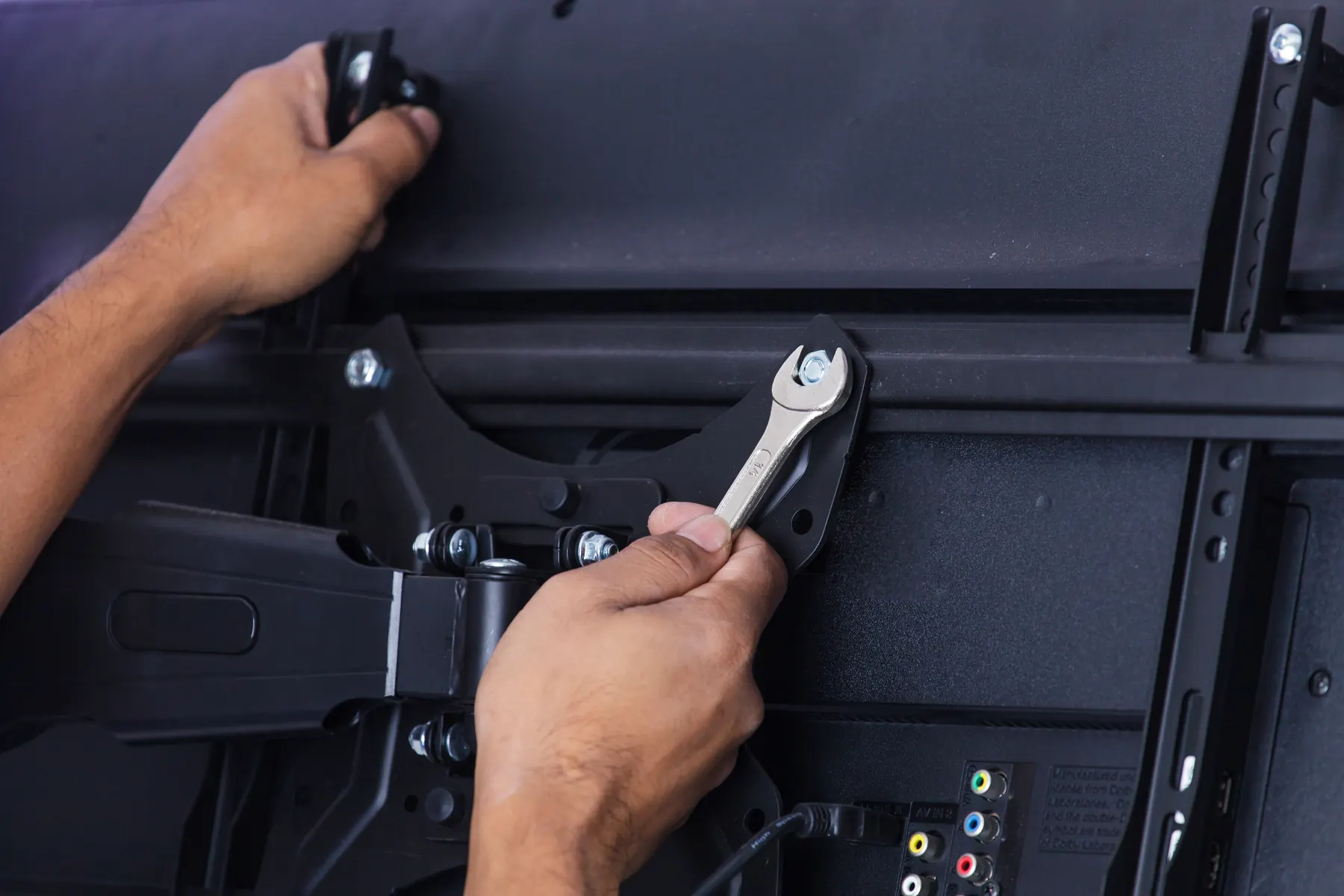
A television bracket is only as good as what it is screwed into. Everything else about a mount, the brand, the tilt, the arm, the finish, matters less than whether the lag screws have landed in solid structure. So before anything goes on a drywall wall, you have to know where the studs are and what they are made of.
Sixteen inches, usually
In most North American housing the studs inside a drywall wall run vertically at 16 inch centres, measured from the middle of one to the middle of the next. Some walls, particularly newer ones and some interior partitions, are framed at 24 inches instead. Both are normal. The practical difference is that at 24 inch spacing a bracket has to be wider to catch two of them, and some brackets simply will not reach.
Spacing is a pattern, not a promise. Around a door, a window, a corner or an old opening that has been boarded over, the framing does whatever the carpenter needed it to do. Find one stud, then measure 16 inches and check. If it is not there, try 24. If neither, the wall is not standard and it is worth knowing why.
Timber or steel, and why it changes the fixing
Tap the wall and you learn very little. What matters is whether the framing is timber or light gauge steel, because the fixing is completely different.
Into timber, a lag screw bites along its whole length and the wood grips it. That is the strongest and simplest fixing in the trade. Into steel, there is nothing to bite: a steel stud is a thin folded C section, often about as thick as a credit card, and a lag screw will strip the thread out of it under load. Steel needs a toggle rated for steel stud work, which passes through the web and spreads the load against the back of it, or it needs the bracket fixed to something else entirely.
Steel is common in condos, in commercial fit outs and in basement framing, and it is not weaker than timber when it is fixed correctly. It is only weaker when somebody treats it as timber.
Why one stud is not enough
A small screen on a flat plate can live on a single stud. A large one cannot, and a large one on an arm definitely cannot.
The reason is leverage. A flat mount holds the weight close to the wall and the load is mostly straight down. An articulated arm extended two feet puts that same weight two feet out from the fixings, which tries to pull the top bolts out of the wall and crush the bottom ones into it. Fixed into one stud, the plate can also rotate around that line.
Two studs, four lag screws, and the load is shared and braced. If the position you want falls between studs, the answer is not more anchors. It is a piece of timber or plywood fixed across two studs behind the plate, or a bracket wide enough to reach both.
Drywall anchors are not rated for this
Toggles and plastic plugs have a place. They hold shelves, curtain tracks and mirrors. They are not a mount for a television on an arm, whatever the packet says, because the figure on the packet is a straight pull test on new board in a laboratory, not a cantilevered load cycling every day for years.
Drywall is gypsum. It crumbles. An anchor in it is gripping roughly half an inch of chalk, and the failure mode is not a clean snap. The hole slowly grows, the plate shifts a fraction, the load concentrates on fewer anchors, and then the whole thing comes off the wall with a corner of the board still attached.
Where a stud finder lies
A stud finder is a density sensor or a magnet, not an x-ray. It is useful and it is routinely wrong in the same handful of places.
It reads a stud where there is none: over a joint where two boards meet and the compound is thick, over a metal corner bead at an external angle, over a run of ducting. It misses a stud where there is one: under thick plaster, under tile, under a double layer of board.
And it tells you nothing about what is inside the cavity. Copper pipe, heating pipe, wiring dropping down from a switch. That is why a fixing goes in after a short test hole, or after the depth is set so the bit stops at the back of the board.